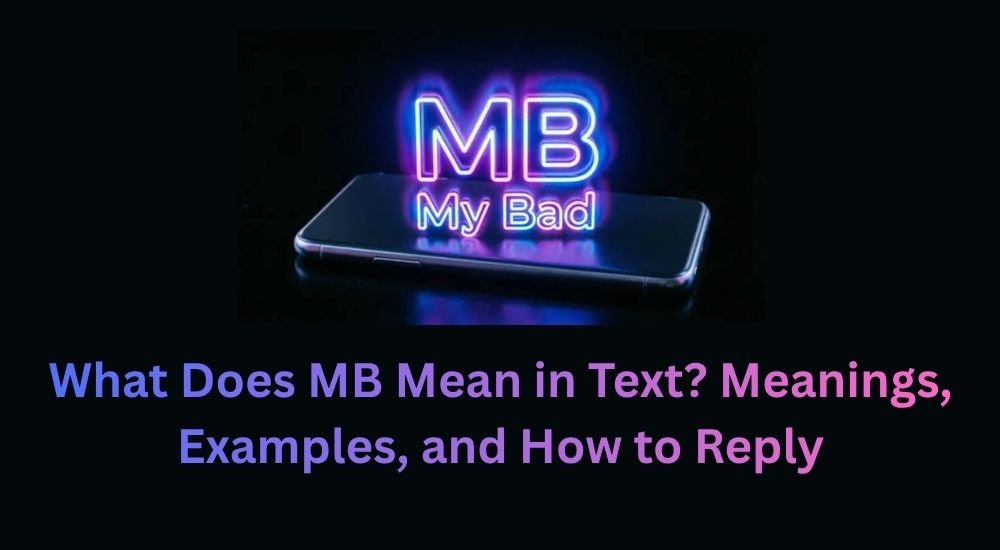
What Does MB Mean in Text? Meanings, Examples, and How to Reply
Have you received a text saying “mb” and wondered what it means? In most casual conversations, MB means “my bad.” People use it to admit a small mistake, apologize for a misunderstanding, or correct something they said earlier.
However, MB can also mean “maybe” when someone is unsure about a plan. In technical conversations, it stands for “megabyte,” a unit used to describe digital file sizes. The meaning depends on the context.
This guide explains the different meanings of MB, how people use it in text messages, and how to reply naturally.
Key Takeaways
- MB usually means “my bad” in casual text messages.
- It is a quick way to admit a small mistake or apologize.
- MB can mean “maybe” when someone is unsure about a plan.
- In technology, MB stands for megabyte.
- The surrounding conversation helps you identify the correct meaning.
- A full apology is better when a mistake is serious.
What Does MB Mean in Texting?
MB most commonly stands for “my bad.” It is an informal expression people use when they make a mistake or realize they have misunderstood something.
For example:
Alex: You sent me the wrong address.
Sam: Oh, mb! I’ll send the correct one.
Sam uses MB to acknowledge the mistake and apologize. The abbreviation keeps the conversation short and relaxed.
People commonly use MB with friends, family members, classmates, gaming teammates, and familiar coworkers. It is popular in casual chats because it takes less time to type than the full phrase.
What Does MB Stand For?
MB has three common meanings, depending on the conversation:
- My bad: A casual way to admit a mistake.
- Maybe: An uncertain answer about a plan or possibility.
- Megabyte: A unit used to measure digital file sizes.
In everyday texting, “my bad” is usually the first meaning to consider. However, the complete message provides the best clue.
Why Do People Use MB in Messages?
People use MB because it is short, convenient, and easy to understand in casual conversations. Instead of typing a full apology, they can acknowledge a small mistake with two letters.
For example, someone might write “mb, I forgot to call you” after missing a phone call. Another person might use it after sending the wrong link.
MB works best when the mistake is minor and both people understand the informal tone.
What Does MB Mean in Different Situations?
The meaning of MB changes with the topic. Looking at the surrounding words can help you understand what the sender intends.
MB Meaning “My Bad”
This is the most common meaning in everyday texting. It shows that the sender recognizes a mistake or accepts responsibility for something that went wrong.
Example:
Mia: You said we were meeting at 5, but it’s 6 now.
Noah: Mb, I got the time mixed up.
Noah uses MB to acknowledge the misunderstanding and apologize.
MB Meaning “Maybe”
MB can also stand for “maybe” when someone is unsure about a question, invitation, or future plan.
Example:
Ella: Are you coming to the party tonight?
Liam: Mb, I need to finish my work first.
Liam has not made a definite decision. Here, “maybe” fits the conversation better than “my bad.”
This meaning is less common in some texting situations, so consider whether the message expresses uncertainty rather than an apology.
MB Meaning “Megabyte”
In technology, MB stands for megabyte. It describes the size of digital files, images, downloads, and other data.
Example:
Chris: Why can’t you send the video?
Jordan: It’s 120 MB. I’ll upload it and share the link.
The number and discussion about a video show that MB refers to file size, not slang.
What Does MB Mean in Gaming Chats?
Gamers often use MB to mean “my bad” when they make a mistake during a match.
Example:
Player 1: You left the team without backup!
Player 2: Mb, I thought you were covering that side.
The second player admits the mistake without interrupting the game with a long explanation.
In multiplayer games, MB can acknowledge a missed move, poor timing, or a wrong decision.
What Does MB Mean in Group Chats?
In group chats, MB usually means “my bad” when someone shares incorrect information, misses a message, or misunderstands a conversation.
Example:
Taylor: The meeting is at 3, not 4.
Morgan: Mb, everyone. I shared the wrong time earlier.
Morgan corrects the mistake and makes sure the group understands what happened.
Adding a short explanation after MB is helpful when several people may have seen the original message.
How to Understand MB From Context
The easiest way to understand MB is to read the entire message rather than focusing on the abbreviation alone.
| Message or situation | Likely meaning | Reason |
| “mb, I forgot” | My bad | The sender admits a mistake |
| “mb, I read it wrong” | My bad | The sender acknowledges an error |
| “mb, maybe tomorrow” | Maybe | The sender is unsure about a plan |
| “Are you free tonight?” “mb” | Maybe | The reply expresses uncertainty |
| “The file is 50 MB” | Megabyte | The message discusses file size |
Clues That MB Means “My Bad”
Look for words that describe a mistake, correction, or apology. Phrases such as “I forgot,” “I misunderstood,” and “I sent the wrong one” often point to “my bad.”
For example, “mb, I didn’t see your message” means the sender is acknowledging that they missed your message.
When MB Means “Maybe”
If someone uses MB to answer a question about plans, availability, or future events, they may mean “maybe.”
For example, “mb next week” suggests that the person might be available next week but has not confirmed.
If both meanings seem possible, ask the sender what they mean instead of guessing.
How to Tell Slang MB From Technical MB
Pay attention to the subject of the conversation.
If people are discussing mistakes, plans, or apologies, MB is probably slang. If they are talking about downloads, storage, or digital attachments, MB probably means megabyte.
Capitalization alone is not a reliable clue because people often type slang in either uppercase or lowercase.
Real-Life Examples of MB in Text Messages
Here are a few everyday examples of how people use MB in conversations.
MB After a Small Mistake
Ava: You sent the old document again.
Ben: Mb, here’s the updated version.
Ben acknowledges the mistake and provides the correct document.
MB When Someone Replies Late
Olivia: I messaged you this morning.
Ethan: Mb, I was busy and forgot to reply.
Ethan apologizes for missing the message and briefly explains what happened.
MB During Plans With Friends
Sophie: We said 7, remember?
Daniel: Mb, I thought you meant 7:30.
Daniel admits that he misunderstood the agreed time.
MB in an Online Game
Player 1: We lost because you moved too early.
Player 2: Mb, I’ll wait for the team next time.
The player accepts responsibility and explains what they will do differently.
MB When Discussing File Sizes
Riley: Can you send me the picture?
Casey: Sure, it’s only 3 MB.
Here, MB means megabytes because the conversation is about the size of a picture.
What Tone Does MB Have in a Text?
MB usually sounds casual and relaxed. It can make a small apology feel natural without turning a minor mistake into a serious conversation.
However, its tone depends on the situation, the relationship between the people, and the mistake itself.
Does MB Sound Friendly or Rude?
MB is not automatically rude. Among friends, it can sound friendly and show that the sender is willing to admit an error.
For example, “mb 😂 I totally forgot” may sound playful when both people are comfortable with each other.
However, sending only “mb” after causing a serious problem can seem careless. The other person may feel that the sender is not taking the situation seriously.
Can MB Feel Dismissive in a Serious Conversation?
Yes. A short abbreviation may feel dismissive when a mistake has caused real inconvenience or hurt someone’s feelings.
For example, if someone shares private information without permission, replying with only “mb” may not be enough.
A more thoughtful response would be:
“I’m sorry I shared that without asking. I understand why you’re upset, and I won’t do it again.”
A sincere apology should recognize the mistake and explain how the person will make things right when necessary.
How to Reply When Someone Says MB
Your reply depends on the mistake and how you feel about it. You can accept the apology, keep things light, or explain why the issue matters.
Friendly Replies to MB
If the mistake is minor and you are not upset, keep your response simple.
Examples include:
- “No worries!”
- “You’re good.”
- “All good.”
- “It’s okay.”
- “Don’t worry about it.”
These replies show that you accept the apology and are ready to move on.
Funny and Casual Replies
When you are talking to a close friend and the mistake is harmless, a playful response can keep the conversation relaxed.
Examples include:
- “I’ll let it slide 😂”
- “Haha, you’re fine.”
- “It happens!”
- “You’re forgiven.”
Choose a response that matches your usual way of talking. A joke may not be appropriate if the other person is genuinely upset.
Replies When You Are Still Upset
You do not have to accept an apology immediately just because someone says MB.
You can respond honestly without being rude.
Examples include:
- “I understand, but please be more careful next time.”
- “Thanks for apologizing. It caused a problem, though.”
- “I appreciate that, but I need some time.”
- “Please make sure it doesn’t happen again.”
These replies acknowledge the apology while making your feelings or expectations clear.
What to Say When You Do Not Understand MB
If you cannot tell what the sender means, asking a simple question is the easiest solution.
You could say:
- “What do you mean by MB?”
- “Do you mean my bad or maybe?”
- “Can you explain what you mean?”
A quick question can prevent confusion and help you understand the message correctly.
When Should You Use MB in Texting?
MB works best in informal conversations where a short apology is enough to acknowledge a small mistake.
When MB Is Appropriate
You can use MB when you:
- Send the wrong link or attachment.
- Forget to reply to a message.
- Mix up a meeting time.
- Make a small mistake in a game.
- Misunderstand a friend’s message.
- Type something incorrectly and need to correct it.
For example, “mb, I sent the wrong screenshot” is a natural way to acknowledge a simple error.
When You Should Write a Full Apology Instead
Avoid relying on MB when the mistake is serious, the conversation is formal, or the other person needs a proper explanation.
In a work email, you could write, “I’m sorry for sending the incorrect file. I’ve attached the corrected version.”
If you have hurt someone’s feelings, a direct apology is usually more thoughtful than a brief abbreviation.
The goal is not just to admit the mistake. It is to show that you understand the problem and care about fixing it.
What Does MB Mean on Snapchat, Instagram, and Other Apps?
MB generally keeps the same meanings across messaging platforms. The app itself does not determine what the abbreviation means.
MB on Snapchat
On Snapchat, MB commonly means “my bad” in chats and replies.
For example, if someone sends a snap to the wrong person and follows it with “mb,” they are probably acknowledging the mistake.
It can also mean “maybe” when someone answers a question about plans. Read the conversation before deciding.
MB in Instagram DMs
In Instagram direct messages, MB often appears when someone apologizes for a typo, a delayed response, or a misunderstanding.
For example, “mb, I just saw this” means the sender is apologizing for seeing the message late.
The same abbreviation can have a different meaning if the conversation is about plans or technology.
MB on WhatsApp and Messenger
On WhatsApp and Messenger, people use MB in much the same way as they do in other chats.
A friend might write “mb, wrong group” after sending a message to the wrong conversation. In another chat, “mb tomorrow” might mean “maybe tomorrow.”
The surrounding words remain the most useful clue, regardless of the messaging app.
MB vs. Similar Texting Abbreviations
MB is related to several common expressions, but each one serves a different purpose.
| Term | Meaning | Main difference |
| MB | My bad | Admits a mistake |
| Sorry | An apology | Can express regret in casual or serious situations |
| Oops | Recognition of a small mistake | Often sounds playful or surprised |
| DW | Don’t worry | Reassures someone that something is okay |
| IDK | I don’t know | Shows uncertainty or a lack of information |
MB vs. Sorry
MB means “my bad” and usually acknowledges responsibility for a mistake. “Sorry” is more flexible and can express regret, sympathy, or a more serious apology.
For example, “mb, I forgot” sounds casual, while “I’m sorry I forgot your appointment” feels more personal and direct.
MB vs. Oops
Oops is often used when someone notices a mistake or accident. It can sound lighthearted and does not always clearly accept responsibility.
MB more directly communicates that the sender recognizes their own mistake.
MB vs. DW
DW stands for “don’t worry.” It is often used to reassure someone who is apologizing.
Alex: Sorry, I forgot to bring your book.
Jamie: DW, you can bring it tomorrow.
Jamie reassures Alex rather than admitting a mistake.
MB vs. IDK
IDK means “I don’t know.” Unlike MB, it does not usually express an apology.
For example, “IDK if I’m free tomorrow” means the sender is unsure about their availability. MB may also mean “maybe” in a similar conversation, but the two abbreviations are not interchangeable in every sentence.
Common Mistakes People Make When Reading MB
Because MB is short and informal, it is easy to misunderstand it. Keep these common mistakes in mind.
Assuming MB Always Means “My Bad”
Although “my bad” is the most common meaning in casual texting, it is not the only one. A reply about future plans may use MB to mean “maybe.”
Always consider the complete sentence.
Confusing Texting Slang With Megabytes
If someone writes “100 MB,” they are probably talking about a file or amount of digital data, not apologizing.
Numbers and technical topics are useful clues that the abbreviation has a different meaning.
Guessing the Meaning Without Enough Context
Do not assume that MB has a special meaning because someone uses Snapchat, Instagram, or another messaging app. The platform alone cannot tell you what the sender intended.
If the message remains unclear, ask what they mean. A direct question is more reliable than guessing based on capitalization, emojis, or the sender’s gender.
Conclusion
MB usually means “my bad” in texting. It is a quick, casual way to admit a mistake or apologize for a small misunderstanding. However, it can also mean “maybe” when someone is unsure about a plan, or “megabyte” in a technical conversation.
The best way to understand MB is to read the complete message and consider the situation. If someone sends you MB, you can reply with “No worries,” ask what they mean, or offer a more serious response when needed. Understanding the context makes texting abbreviations much easier to interpret.
Frequently Asked Questions
Does MB always mean “my bad”?
No. MB usually means “my bad” in casual chats, but it can also mean “maybe” in uncertain replies or “megabyte” in technical conversations.
Can MB mean “maybe”?
Yes. Someone might write “mb tomorrow” to suggest that they may be available tomorrow. The surrounding conversation helps distinguish this meaning from “my bad.”
What does MB mean on Snapchat or Instagram?
MB commonly means “my bad” on Snapchat and Instagram when someone admits a mistake. It can also mean “maybe,” depending on the message.
Is MB rude?
Not necessarily. MB is usually fine for small mistakes between friends, but it may sound dismissive when the situation calls for a sincere apology or explanation.
Does capitalization change the meaning of MB?
No reliable rule separates “MB” from “mb” in casual texting. The surrounding words and topic are generally more helpful than capitalization alone.
Does MB mean something different from a girl or a guy?
No. MB does not have a fixed meaning based on gender. Consider the conversation and ask for clarification if you cannot tell what the sender means.


2 Comments